Guy Simpson | Was Here
Guy Simpson
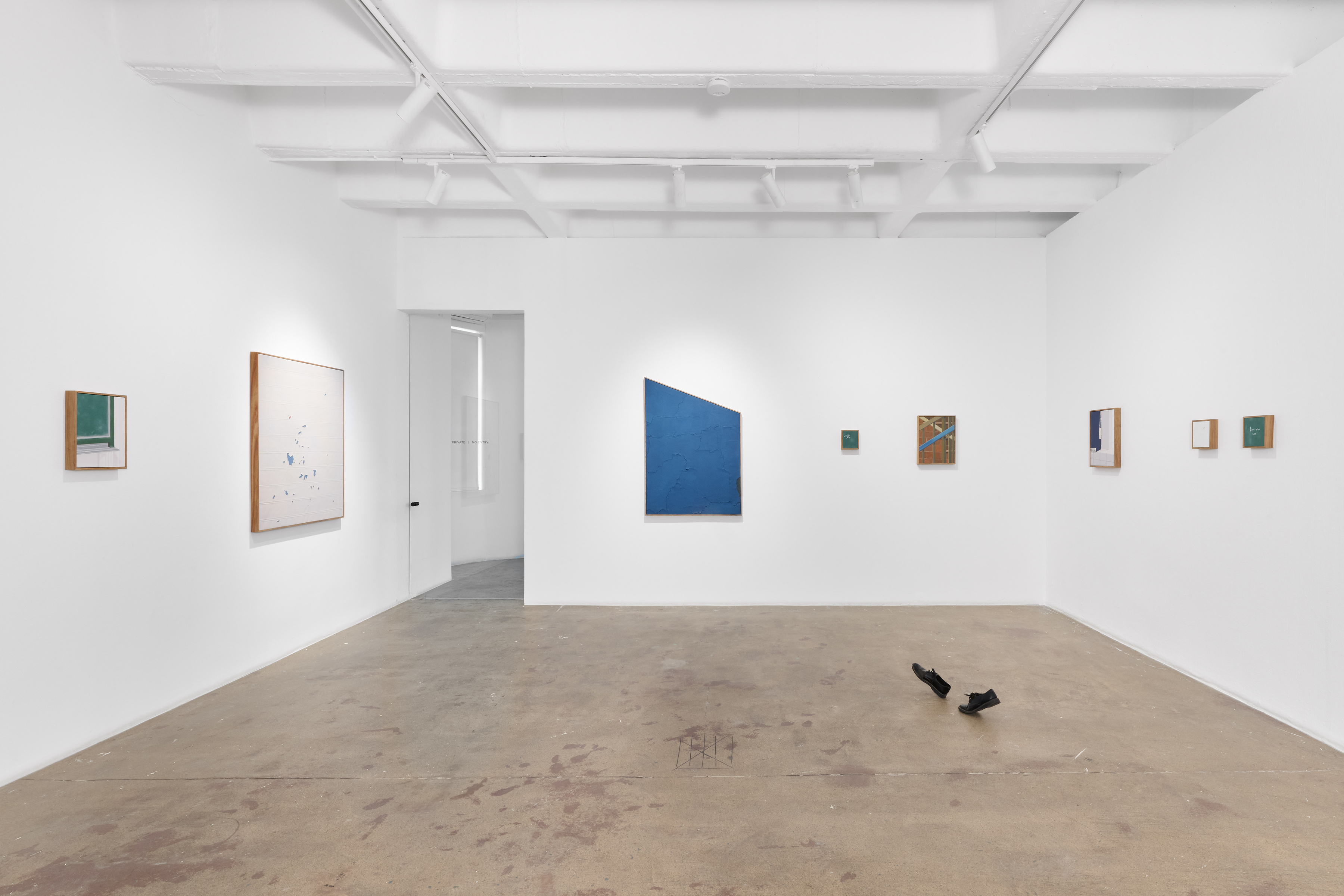
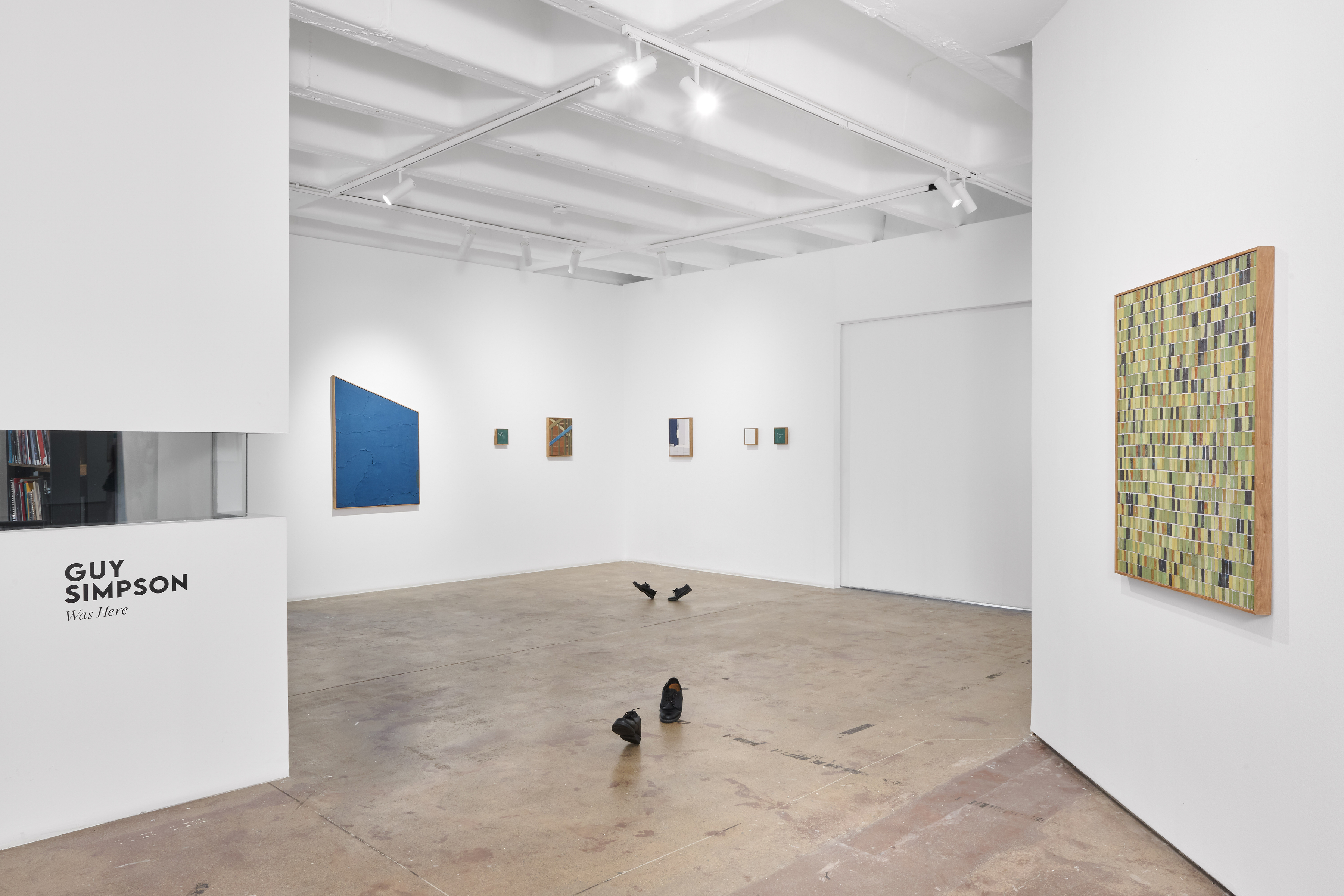
Goodman Gallery Johannesburg is pleased to present Guy’s Simpson’s Was Here his first gallery presentation in the city where he was born and raised. Emerging from a network of artist-run spaces in Cape Town – where he now lives – Simpson’s practice sits at the unusual intersection of documentation and abstraction, translating photographic record into dense, materially layered and extraordinarily innovative and often sculptural paintings. By focussing on the minutiae of the spaces we inhabit, he offers an understated and beautifully tactile meditation on the transitions of places and communities.

GUY SIMPSON
Tuckshop Staircase, 2025
Acrylic, wall paints and micro reflective glass bead on layered canvas
124 x 85.5 cm (48.8 x 33.7 in.)


GUY SIMPSON
Ramp to Primary School Field, 2025
Acrylic, wall paints, wood dust, crafting sand and aluminium filings on layered canvas
130 x 100 cm (51.2 x 39.4 in.)

GUY SIMPSON
Bottom Corridor, 2025
Acrylic, wall paint, wood dust and micro reflective glass beads on layered and creased canvas
112 x 91 cm (44.1 x 35.8 in.)

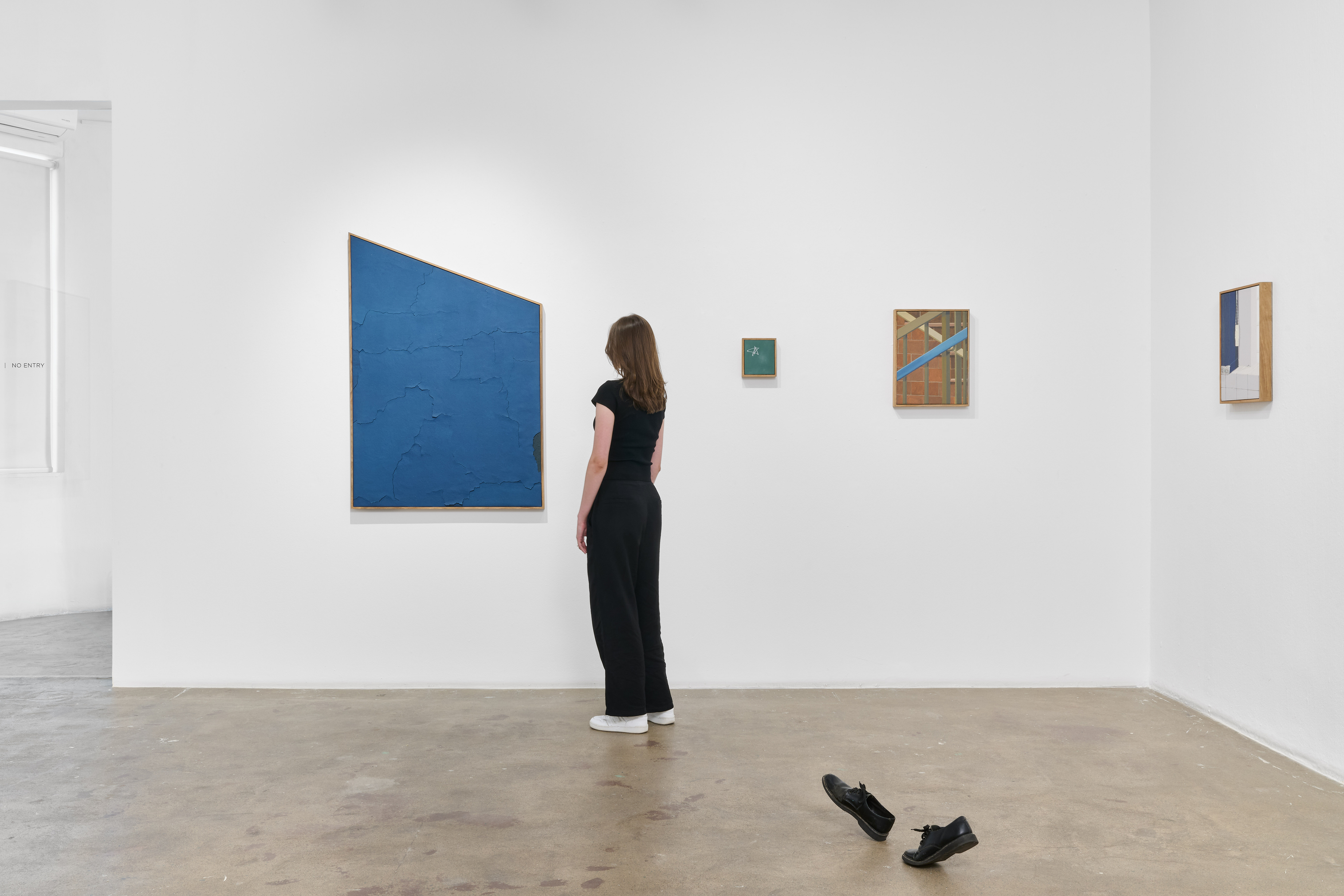
Forming part of Goodman’s newly reimagined Working Title series, which offers a year-round incubator programme for local South African artists led by Goodman curator Nandi Jakuja, Was Here is presented in the Johannesburg gallery’s viewing room space. It brings together a small but powerful group of paintings created by Simpson towards the end of 2025. Returning to Johannesburg to show in this context carries particular resonance for the artist: the school bus that took him from the suburb of Sydenham where he lived to the Jewish day school he eventually attended, King David Victory Park, passed Goodman Gallery every morning.
Born in the year that South Africa officially became a democracy, Simpson has witnessed acute examples of Johannesburg’s shifting suburban landscape: shrinking and consolidating diasporic communities; religious and ethnic enclaves tightening after extensive relocation; generational shifts in belief, belonging and identity. Growing up in Orange Grove and the bordering suburb of Sydenham – where he spent most of his school-going years – Simpson experienced these transitions first-hand. Orange Grove – its evocative name recalling the orange farms of a century ago, rather than its more recent blue-collar reality – was home to Jewish, Italian, Portuguese and Afrikaans communities, many of whom have since dispersed. In an earlier body of work, Simpson mapped this changing terrain through paintings of decaying interior and exterior walls, where peeling paint and ruptured plaster operate as inadvertent urban archives.

GUY SIMPSON
Part of the Shul’s Mozaic, 2025
Acrylic, wall paints and crafting sand on cut and layered canvas
104 x 84.5 cm (40.9 x 33.3 in.)


GUY SIMPSON
Staircase to The Hall, 2025
Acrylic and wall paints on canvas
42 x 32 cm (16.5 x 12.6 in.)
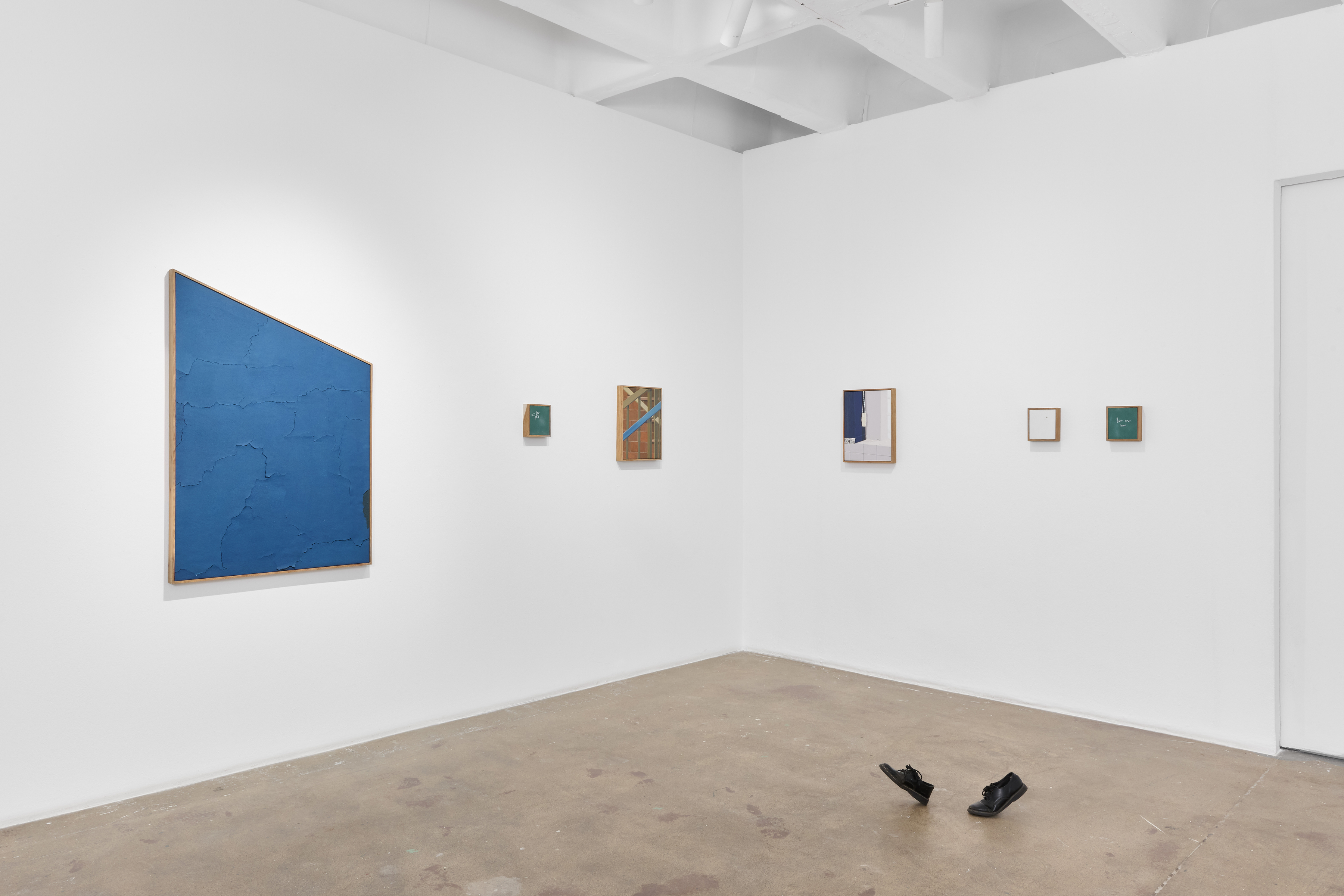

GUY SIMPSON
Folding Chairs in The Shul, 2025
Acrylic and wall paints on canvas
42 x 32 cm (16.5 x 12.6 in.)

Simpson’s approach is shaped in part by artists such as Igshaan Adams – for whom he once worked as a studio assistant – whose materially driven practice draws on the textured surfaces of homes in Langa and Bonteheuwel. While Adams’s work maps social and familial histories through woven and salvaged materials, Simpson adopts a different strategy: he mixes aluminium filings, sawdust and reflective glass into his paint to approximate the grit and tactility of deteriorating spaces. His attention to surface detail also resonates with the hyperreal paintings of Brazilian artist Paulo Nimer Pjota, who layers textures and references in what he describes as a form of visual sampling.

GUY SIMPSON
Hall Blinds, 2025
Acrylic and wall paints on canvas
42 x 32 cm (16.5 x 12.6 in.)


GUY SIMPSON
Change Room Mazuzah, 2025
Acrylic and wall paints on canvas
34.5 x 24.5 cm (13.6 x 9.6 in.)

In this new body of work, Simpson turns from domestic interiors to the now-empty grounds of his former school, whose recent and controversial closure underscores the contraction of Johannesburg’s Jewish community. Before the site was vacated, he photographed and archived the campus, revisiting his ambivalent relationship to Jewish schooling as a way of thinking through broader shifts in the community – demographic shrinkage, increasing securitisation, and ideological divergences between schools. Although not overtly didactic, Simpson notes that such politics remain embedded in the suburbs and spaces he paints.

GUY SIMPSON
Primary School Black Board, 2025
Acrylic and wall paints on canvas
34.5 x 24.5 cm (13.6 x 9.6 in.)


GUY SIMPSON
Sam was here, 2025
Acrylic and wall paints on canvas
15.5 x 13.5 cm (6.1 x 5.3 in.)


GUY SIMPSON
Black Board Star, 2025
Acrylic and wall paints on canvas
15.5 x 13.5 cm (6.1 x 5.3 in.)


GUY SIMPSON
Classroom Bee, 2025
Acrylic and wall paints on canvas
15.5 x 13.5 cm (6.1 x 5.3 in.)
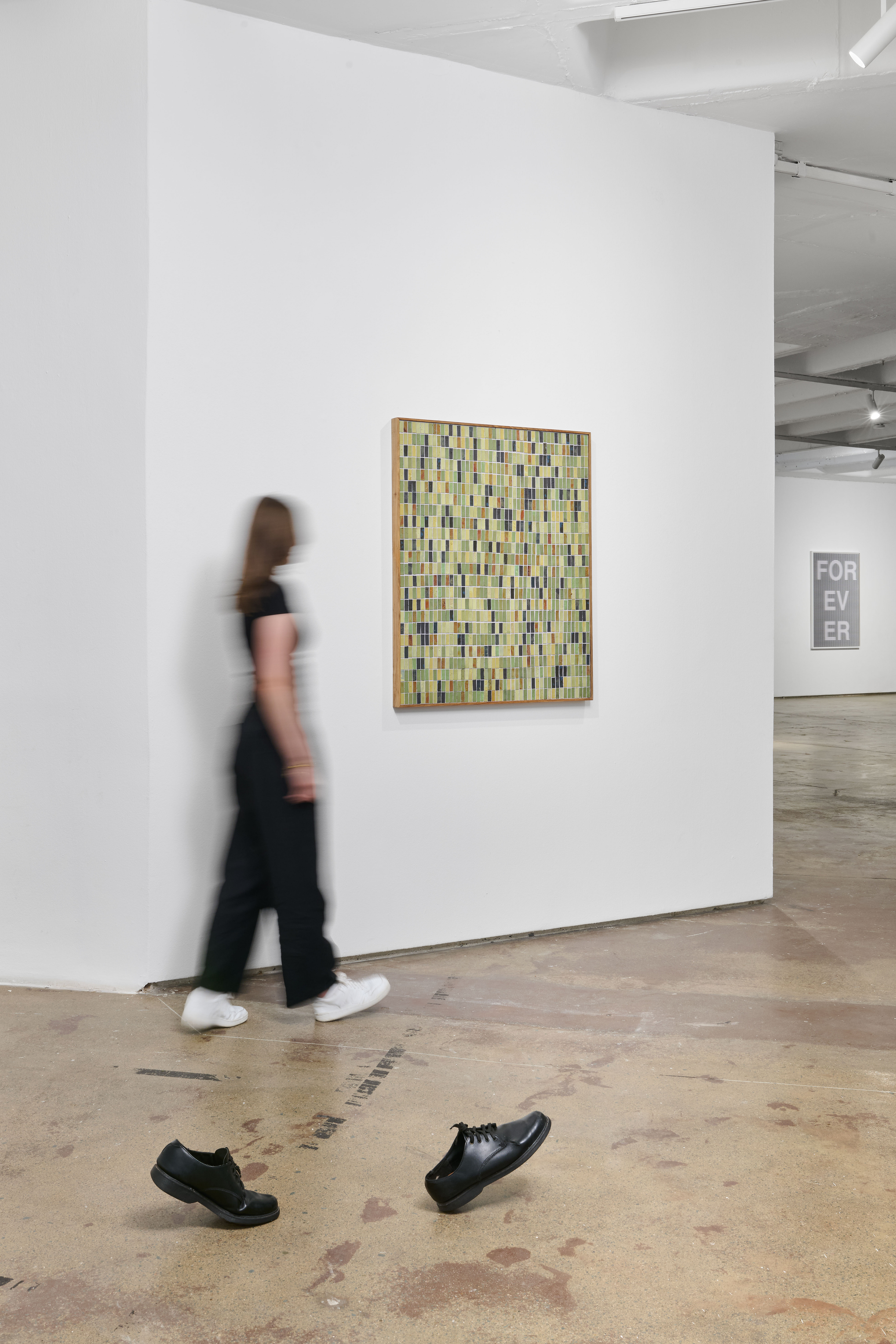
The resulting interior works are small, intimate studies that locate slow or quiet moments around the campus. Although they never depict the human figure, they register presence through detail: seats in the synagogue; the corner of a chalkboard; blinds in the assembly hall; and, the small yet telltale sign of Jewish presence, a mezuzah on a doorframe. These paintings are interspersed with larger works of exterior facades, which set the broader scene, as well as a series of subtly slanted compositions derived from the angled walls built along staircases and ramps throughout the school. These tilted works introduce an unexpected architectural rhythm – a sense of movement, elevation and descent – and echo the shifting ground of a place in transition.
“Brick, cracks and chipping paint act like markers of change,” Simpson reflects. “The change is visible here, and it’s not necessarily ugly. Change is unavoidable and it’s good to acknowledge that.” Complementing the paintings is a trail of sculptural shoes – three pairs, increasing in size – suggesting passage, memory and the simple act of moving through space, of passing by.

Guy Simpson (b. 1994, Johannesburg) is a visual artist who has exhibited extensively in South Africa, with solo exhibitions at Everard Read Cape Town, Breakroom Projects and THK Gallery. Internationally, he has shown with Reservoir during Berlin Art Week and at EIGEN + ART Lab. He has a Bachelor of Contemporary Art from Cape Town Creative Academy (2019) and was shortlisted for the Gasworks London Artist Residency (2024). Simpson has played a significant role in artist-run initiatives, particularly Under Projects, which he co-founded with Luca Evans, Mitchell Gilbert Messina and Brett Seiler in Cape Town. Conceived as a three-month experiment and funded largely through community donations and an art fair booth, the project ran for two years and became an influential platform for emerging and independent artists. Taking no commission and offering residencies and exhibitions, it helped catalyse several careers, including Simpson’s own.