Atta Kwami | Dynamic Equilibrium
Atta Kwami
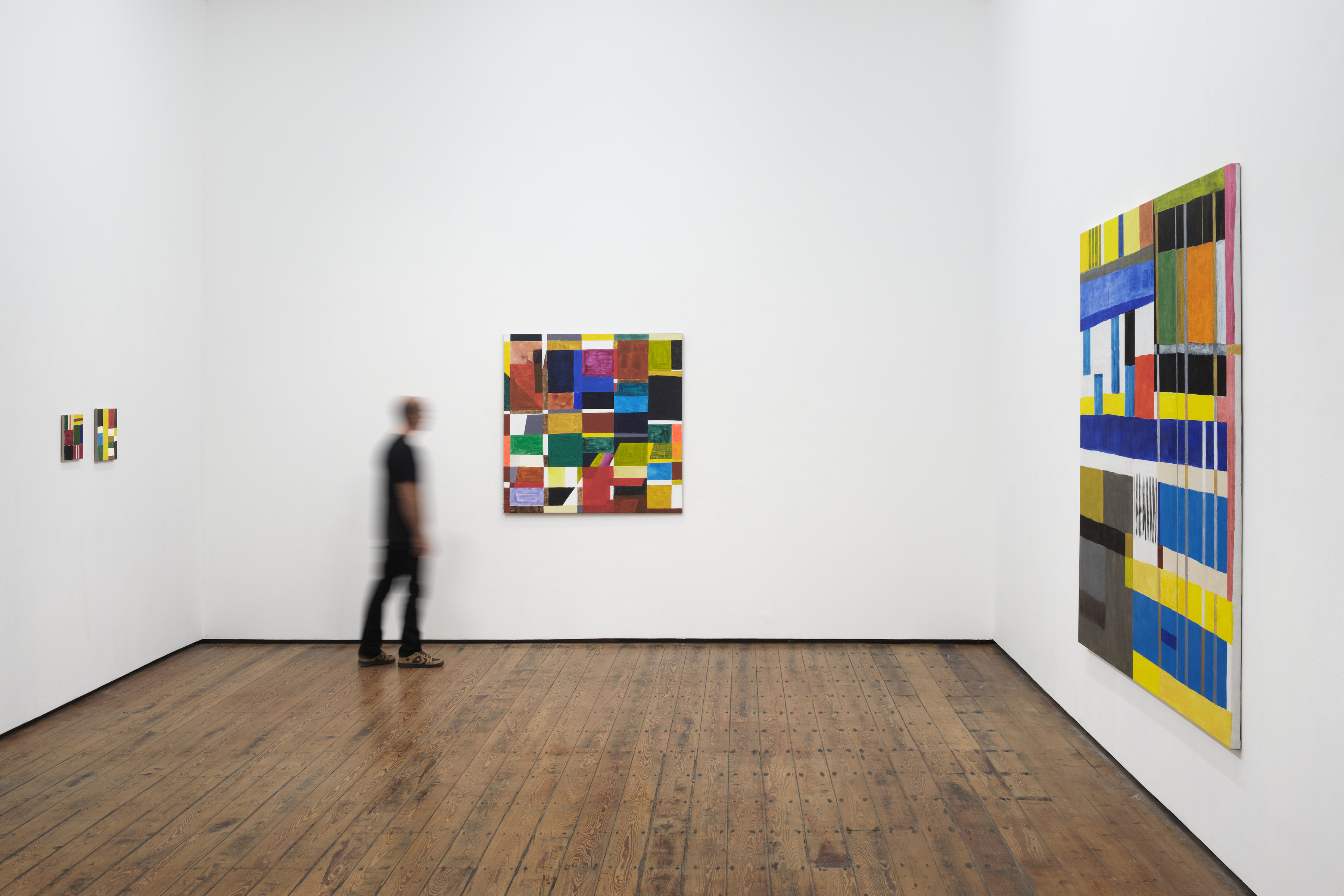
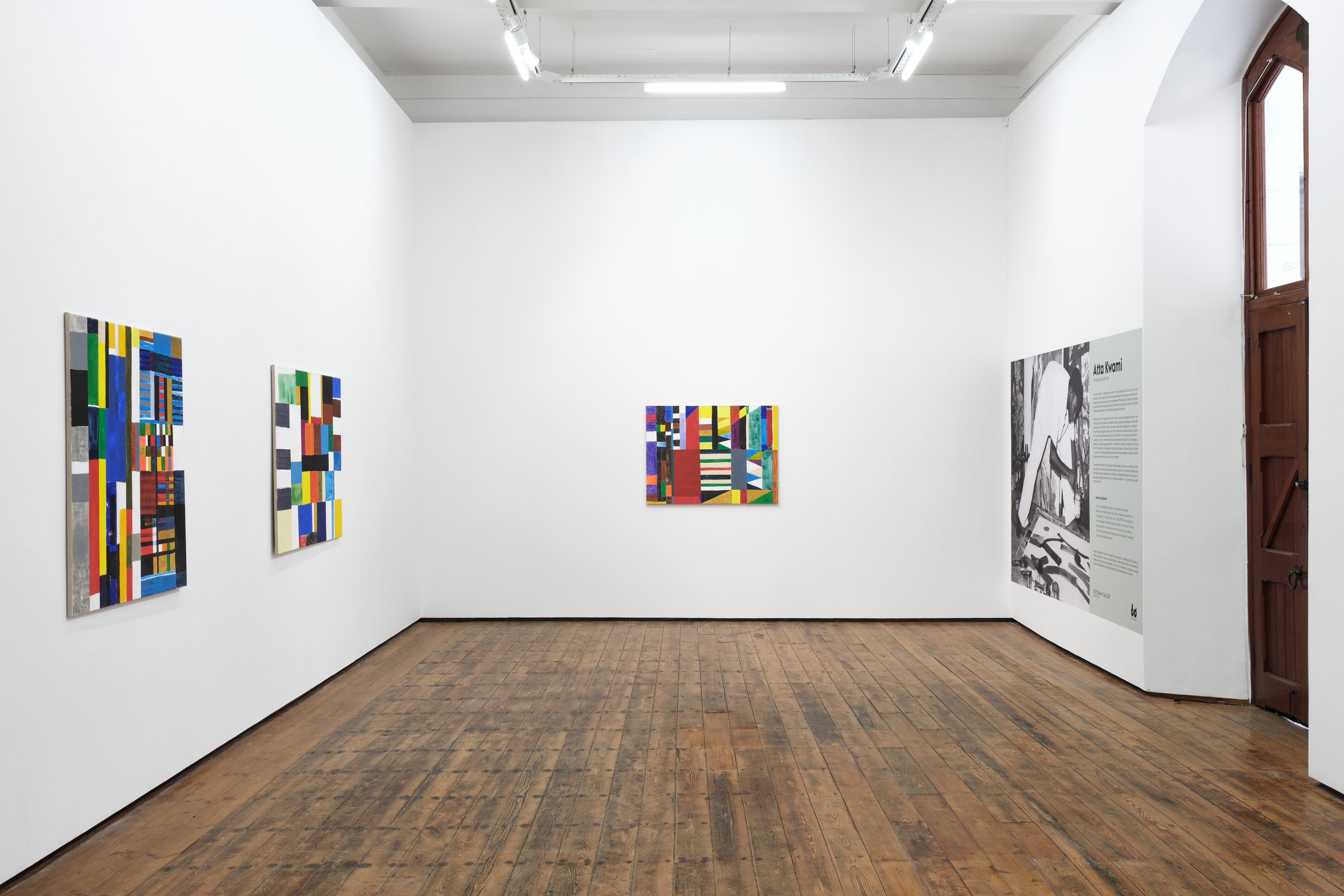
Goodman Gallery is delighted to present Dynamic Equilibrium, Atta Kwami’s second solo exhibition with the gallery since announcing representation of the estate in partnership with Beardsmore Gallery. Spanning works made between 1999 and 2020, the exhibition highlights the breadth of Kwami’s singular practice and reaffirms his place as one of the most important African abstract painters of the late 20th and early 21st centuries.


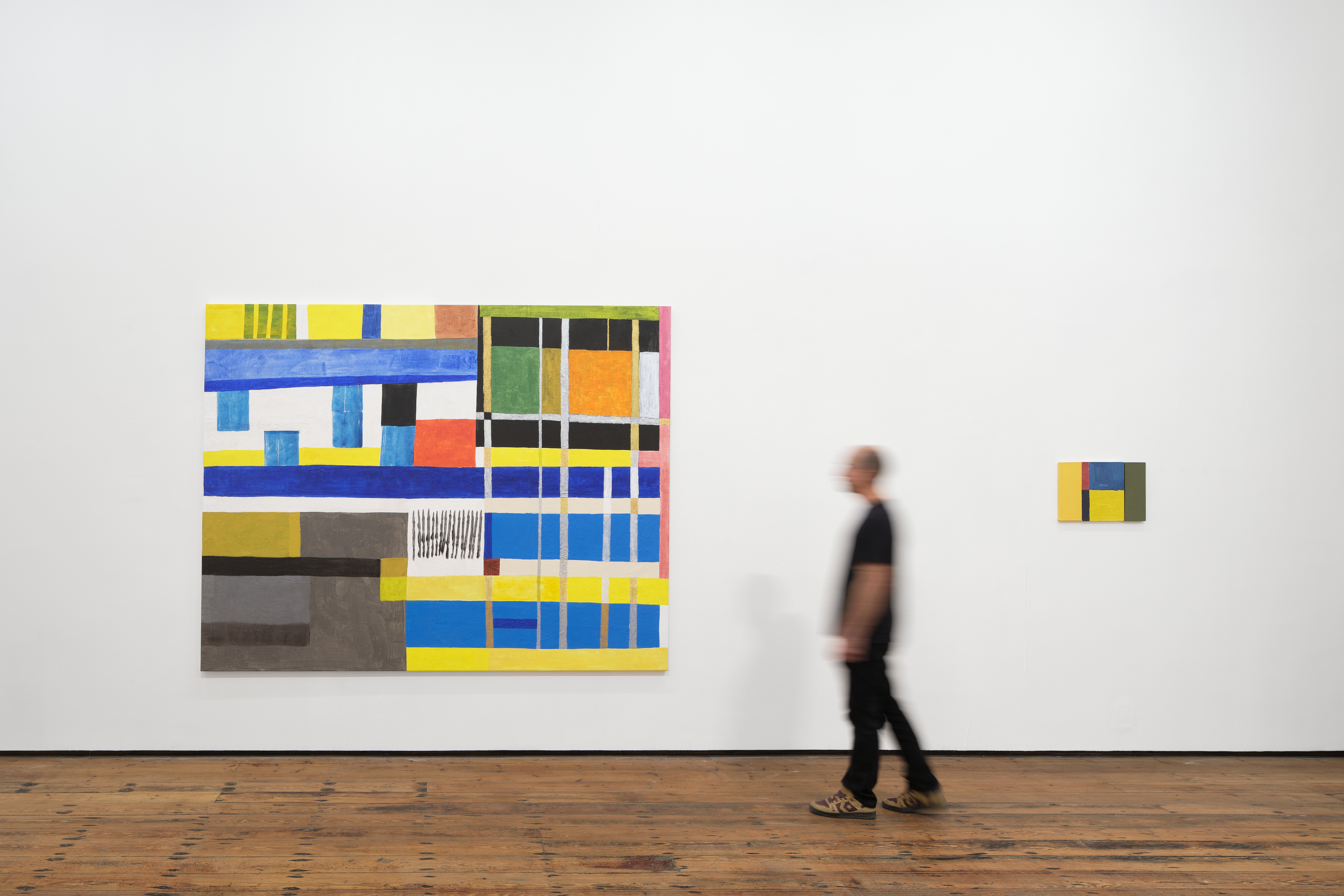


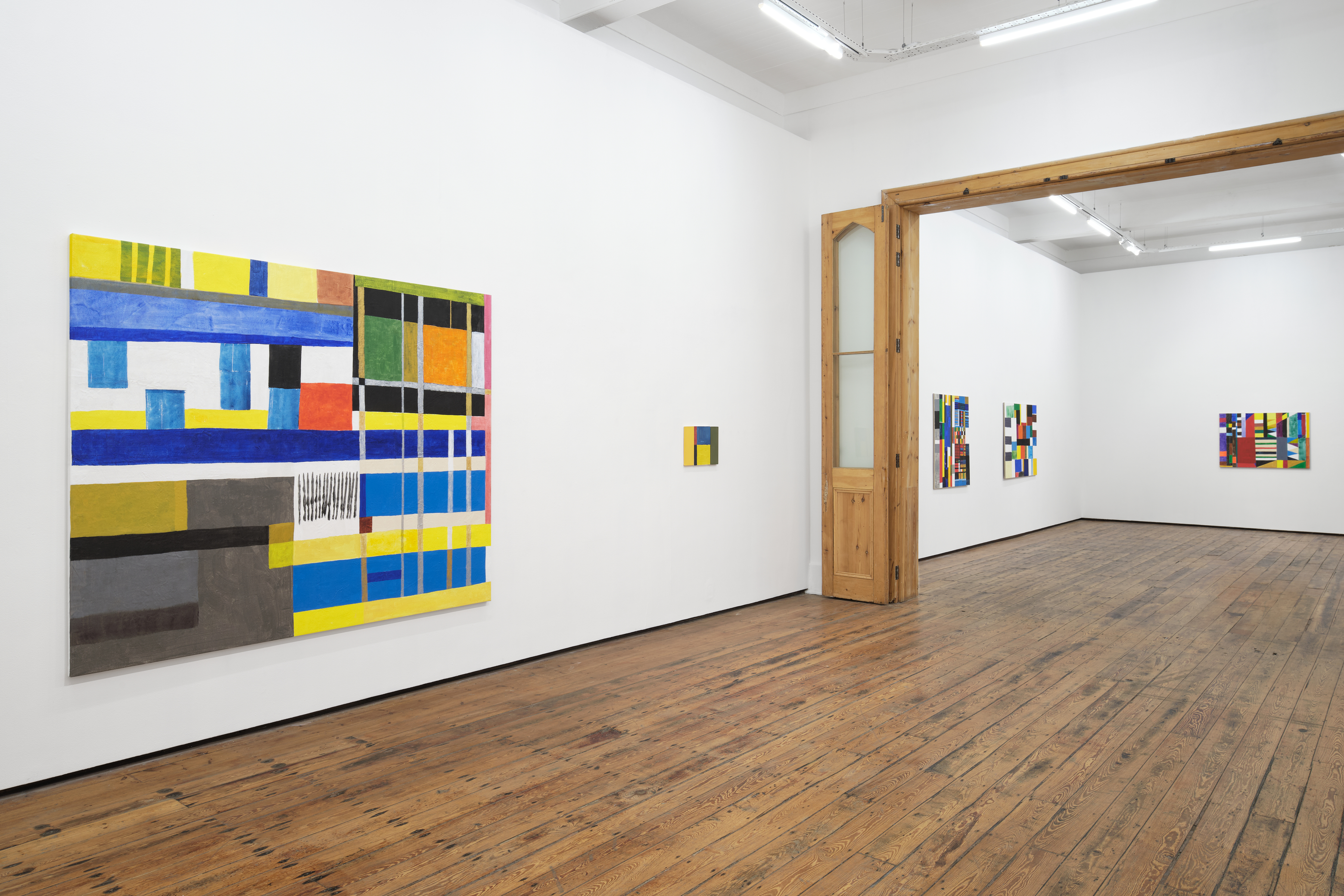
Kwami spent the first fifty years of his life in Africa, a period that shaped his artistic vision in lasting ways. Early influences included the kiosks, hand-painted signage and improvised architecture of West African towns – structures whose forms translated into his paintings in ways that always suggested scale, even in the smallest works. These environments, together with Ewe and Asante textile design, jazz, and the tradition of mural painting, offered him a vocabulary of grids, rhythms and chromatic relationships through which he developed a profoundly original language. Whether in architectural structures or textiles, Kwami found vehicles for exploring the expressive and structural potential of colour: blocks and stripes of uneven sizes converge and diverge in patterns that evoke cadence, syncopation and the paradoxical tensions he sought to hold “in a moment”.

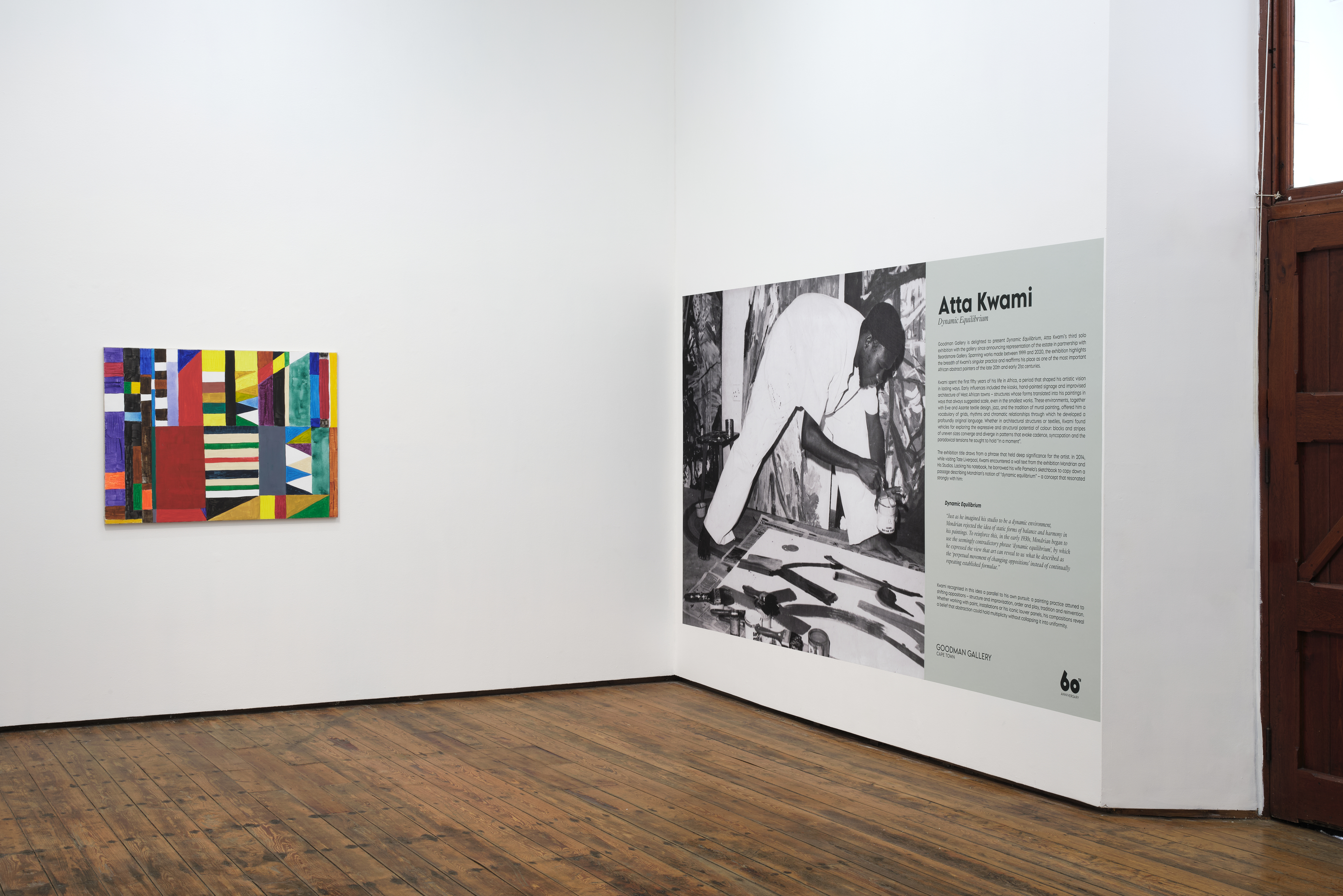


The exhibition title draws from a phrase that held deep significance for the artist. In 2014, while visiting Tate Liverpool, Kwami encountered a wall text from the exhibition Mondrian and His Studios. Lacking his notebook, he borrowed his wife Pamela’s sketchbook to copy down a passage describing Mondrian’s notion of “dynamic equilibrium” – a concept that resonated strongly with him:
Dynamic Equilibrium
“Just as he imagined his studio to be a dynamic environment, Mondrian rejected the idea of static forms of balance and harmony in his paintings. To reinforce this, in the early 1930s, Mondrian began to use the seemingly contradictory phrase ‘dynamic equilibrium’, by which he expressed the view that art can reveal to us what he described as the ‘perpetual movement of changing oppositions’ instead of continually repeating established formulae.”


"Kwami is known for expanding the notions of painting, basing his practice both in the visual world of his native Ghana and in reflections on modernism."
MELISSA BLANCHFLOWER


ATTA KWAMI
Sika Futuru I and II, 2017
Oil on linen - Diptych
Left: 27 x 28 cm (10.6 x 11 in.)
Right: 25 x 27 cm (9.8 x 10.6 in.)
Kwami recognised in this idea a parallel to his own pursuit: a painting practice attuned to shifting oppositions – structure and improvisation, order and play, tradition and reinvention. Whether working with paint, installations or his iconic louver panels, his compositions reveal a belief that abstraction could hold multiplicity without collapsing it into uniformity.
In addition, colour was central to Kwami’s thinking – expressive, structural, symbolic. Works titled Sika Futuru (Gold Dust, in Twi) draw on associations of value, shimmer and luminosity, while Red Gold Green references the colours shared across Ghanaian and pan-African cultural identity. His palette often draws subtle parallels with Mondrian’s use of primary colour as a vehicle for clarity and tension, yet Kwami reimagines these relationships through West African chromatic traditions. Across the exhibition, blocks and stripes of uneven sizes converge and diverge in patterns that evoke cadence, syncopation and the paradoxical tensions he sought to hold “in a moment.”


To show Dynamic Equilibrium in Cape Town is to return Kwami’s work to a context that helped shape his artistic relationships and his investment in pan-African dialogue. The artist’s connection to South Africa stretches back decades. In 1997, he was an artist-in-residence at the Bag Factory Artists’ Studios in Johannesburg; that same year he exhibited a green-and-yellow hut at the Johannesburg Biennale – an homage to the street kiosks of Ghana. He later coordinated the SaNsA International Artists’ Workshop in Kumasi, Ghana, as part of the global Triangle Arts Trust network, a platform that facilitated collaboration and exchange among artists across Africa and the world.


Seen together, the works in Dynamic Equilibrium offer a renewed appreciation of Kwami’s lifelong engagement with the built environment, music, textile traditions and abstraction. They testify to an artist who continually expanded the possibilities of painting, finding within the grid a space for freedom, contradiction, and the “perpetual movement” that animated his vision.

Atta Kwami (b. 1956, Accra, Ghana, d. 2021, UK) studied, and later taught at the Kwame Nkrumah University of Science and Technology (KNUST). In 2007, Kwami received a PhD in art history, now published as Kumasi Realism, 1951-2007: An African Modernism, in which he sought to explore past and present influences on West African art, with an emphasis on street art traditions throughout
Kumasi, Ghana. Kwami’s contribution to art in Africa and beyond has been widely recognised. In Spring 2025, the monograph Atta Kwami, edited by Melissa Blanchflower, was published – the first major publication to chart the full range of his practice. The book followed the prestigious Maria Lassnig Prize, awarded to Kwami in 2021, the year of his death. His kiosk-like structure Money Can’t Buy It and several paintings were recently included in the 2025 exhibition Space Making at Astrup Fearnley Museet in Norway, shown alongside artists including Miyoko Ito and Vivian Suter. Solo exhibitions include: National Museum of African Art, Smithsonian Institution, Washington DC (1994-1995), SOAS, University College of London (1996), Geometric Organic, National Museum Accra (1998-1999) and Kunsthalle Basel, Basel (2001). Kwami’s work is included in major collections around the world, including the National Museums of Ghana and Kenya; the V&A Museum, London; British Museum, London; the National Museum of African Art, Washington, DC; The Metropolitan Museum of Art, New York; Brooklyn Museum, Brooklyn, New York.